I haven't ridden my horse nearly as much as usual, this summer. So it had been awhile since I went down near the Missouri River to see how what was happening with the crops on the rich bottom-ground. On the way there, I noticed someone planted some winter wheat. This crop will go dormant during winter, but at the first hint of spring it will green up again and grow. It can often be harvested in time for the farmer to plant soybeans in the same spot, thus getting two crops off the same bit of ground in one growing season.
 There are still plenty of soybeans left to harvest.
 The line of trees in the distance marks the bank of the Missouri River, which was my original destination.
 But I didn't make it, because I found a flurry of activity on the way there.
 Farmers are combining soybeans!
 The combine is creating quite a cloud of chaff and dust. What do you suppose this farmer thinks of a lady on horseback taking his picture? He isn't one of the farmers I'm acquainted with, but at least nobody told me to get off his property.
 One truck is loaded with soybeans, one is waiting to be filled.
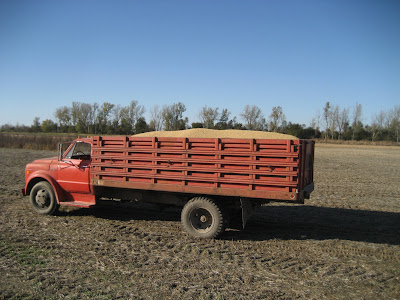 Now that's a lot of soybeans. Perhaps some of them will wind up in the next bottle of vegetable oil you buy at the grocery store; although the largest portion of soybeans is used as protein in livestock feed. It's mind-boggling, though, the many uses for this crop.
It was a good two-hour ride, and a perfect day for it.
 An ocean of soybean plants.
 That may look like a full moon, but it's the sun behind a cloud-cover.
 And the sun is getting brighter!
 I always end up breaking cobwebs here. Nobody lives on this section of the road leading to the river bottoms, and even if a vehicle comes through, it isn't tall enough to get the pesky webs that hit me right in the face.
 Two German Shepherds live here, but only one leaves the yard. This guy acts vicious, but if I point at him and shout, he gets back. Or even if I just stop near him.
 This is a sample of Missouri marijuana that grows wild along the roadsides. Before the Civil War, hemp was raised to make rope: A Civil War skirmish at Lexington was called "Battle of the Hemp Bales". I assume this wild stuff descends from the old hemp used for rope. I've been told it isn't of good enough quality for smoking. I know that Blue, who will eat almost any variety of weed, grass, or tree-limb, won't even taste it. That's probably a good thing!
A few other pictures of my morning ride HERE.
For those of you who have never owned a horse, I want you to realize that you don't just decide to go for a ride, hop on the horse two minutes later, and go. Nope.Before I leave the house, I have to remember some very important details.
1. Change to a sports bra. Now, this next may be too much information, but...
2. I deleted this step; my husband wasn't comfortable with it; it involved another item of underwear... (think "going Commando"). Those of you with bloglines will read it as originally written, I'm sure.
3. Make sure I'm wearing either sweats or Wrangler jeans. Anything else means misery within fifteen minutes of getting on the horse.
4. Put on my fanny-pack, making sure it contains my cell phone and the digital camera.
 5. Use OFF insect repellent liberally, especially if I'm heading toward the river.
6. Time to head to the barn. If I haven't put Blue in the lot already, I could be in for a twenty-minute search around the pasture.
7. Lead Blue to the barn. If he's rolled in the mud, it'll be caked on his back like cement, and lots of curry-combing is in order. If he doesn't seem dirty, I still curry him, just in case there's something on him that could get trapped under the saddle and cause him discomfort.
8. Use the hoof-pick to clean his feet.
 9. Spray Endure on the horse, to keep the flies and mosquitoes off.
 10. Use Wipe on Blue's ears and face, because he goes ballistic if I spray those areas with Endure.
11. Saddle up and ride; it's been at least twenty-five minutes since I first decided to take a ride.Most every morning ride I take starts off with a sunrise shot.
 This is an area of the river bottom that hasn't been tilled since the flood. It looks dry, but it's still mucky, making it hard work for Blue to walk through it.
 That's Blue's tracks.
 Can you see the tiny soybeans peeking up?
 There's one!
 Farmer Steve's equipment is ready to go to work as soon as he gets up this morning.
 Blue and I are heading toward home now. There's a train in the distance.
 Ah, Farmer John caught a racoon!
 Back home, I give Blue some sweet feed. He doesn't require grain, since he only works for an average of two hours, every other day. But he shows me such a good time, I like to let him have a treat.

 There are still plenty of soybeans left to harvest.
 But I didn't make it, because I found a flurry of activity on the way there.
 Farmers are combining soybeans!
 The combine is creating quite a cloud of chaff and dust. What do you suppose this farmer thinks of a lady on horseback taking his picture? He isn't one of the farmers I'm acquainted with, but at least nobody told me to get off his property.
 One truck is loaded with soybeans, one is waiting to be filled.
 Now that's a lot of soybeans. Perhaps some of them will wind up in the next bottle of vegetable oil you buy at the grocery store; although the largest portion of soybeans is used as protein in livestock feed. It's mind-boggling, though, the many uses for this crop.


